 In the last month we’ve had some news sources trying an unconventional method of reaching new audiences: Facebook. “Go where your readers live” is the message of news applications within Facebook, and there is certainly no shortage of people who spend a significant amount of time checking in on Facebook throughout the day, whether it is to update their own account or to see what’s going on with their friends and other businesses/events they follow. Today we’re looking at a few of these Facebook-integrated news apps, including WSJ Social by the Wall Street Journal, The Washington Post Social Reader, and The Guardian on Facebook.
WHY INSIDE OF FACEBOOK?
For companies who need advertising revenue and care deeply about page impressions, length-of-time-on-site and other metrics to share with their advertisers, going to an external site and creating a [free] presence there seems like an odd strategy. But there are a few things Facebook offers companies who want to build a reader on top of their platform. First of all, regarding ad revenue, all is not lost. Facebook can sell ad positions around the app just like any of their other content or pages. However any ads appearing inside the app itself are revenue for the app creators. Secondly, the sharing and social nature of Facebook allows extra, free publicity. Readers can easily share and recommend articles to their friends who may not be regular readers of the publication and may take an interest, check out the article, subscribe, etc. Basically Facebook provides a large population of actively sharing, potential readers.
And news sites need to care about where their readers are. Nielsen published a report in September showing where Americans spend their time online. While social network sites like Facebook checked in at 22.5%, reading current events and global news was a paltry 2.6% of overall Internet time.
Subscription costs and pay walls are still important revenue concepts for news sites. While all of the apps discussed below are free, it remains to be seen if they all stay that way. The WSJ Social indicates on their site that content is currently free for an undisclosed limited time, courtesy of their launch sponsor (Dell). As all three apps have links on each article to view it on the original site, I’m not sure what happens if you do that and run into a pay wall.

WSJ SOCIAL
WSJ Social launched about a month ago, right before Facebook’s developer conference F8. Unlike other Facebook news apps like The Washington Post Social Reader, The WSJ Social was a Wall Street Journal-only project, not initiated or otherwise influenced by Facebook itself. The Wall Street Journal have made all content from wsj.com available on WSJ Social, which is surprising to some, considering their pay wall and subscription charges.
Clicking on the WSJ Social app takes you to a Flipboard-style grid layout of articles, showing titles, images, icons of friends who may have read the article, and comment / like counts. On the left you have a column of your “Top Editors.” Clicking on the Help & Information Center tells you that in WSJ Social, you and your friends are editors, and your top editors can be anyone you have chosen to add to your editor list, whether or not they are your Facebook friends. Clicking the plus and minus buttons adds and removes editors, respectively.

The article view is quite similar to the regular web view, albeit a little less cluttered. It’s a cleaner feel, and a distinct lack of “What’s popular today” and “Most discussed articles” type of content blocks. You’ll see comments left by other Facebook users, and have the opportunity to post comments to both the article and your own Facebook feed.

THE WASHINGTON POST SOCIAL READER
The Washington Post Social Reader pulls its stories both from its http://www.washingtonpost.com front page as well as its content partners including The Associated Press, Reuters, Mashable, GlobalPost, etc. Every person will see something different on the front page of the app, as the stories shown reflect a user’s profile and likes as well as stories read and liked by friends.
The top of the app is comfortable to read, showing a headline story and two other top stories. What follows are two columns of article headlines, images and short descriptions, along with the article source and timestamp. They show a small box on the right of trending stories, and on the left they show a column featuring what friends are reading or have read. This column, powered by Trove, feels redundant, because at the same time you have Facebook’s column on the far right telling you what your friends are doing with apps right at this moment.

Viewing articles is a similar experience to reading articles with the WSJ Social. The article is generally a cleaner version of the one on their site and has less distractions, advertisements and unrelated content boxes. You can leave comments on the article and your own Facebook wall.

THE GUARDIAN ON FACEBOOK
The Guardian is no stranger to new and interesting approaches to sharing their content. Their app, which has the most users of the three, is a very different style and looks more like it is actually part of Facebook, possibly due to the colours and fonts used.
The Guardian on Facebook features an activity stream like the Washington Post Social Reader, showing what your friends have read recently. It has a 3-column box showing popular content right now, and a grid below of larger images showing articles people are commenting on most recently. Underneath that is an additional grid of latest features and links to other Guardian Facebook pages.

Article views are again cleaner. They show links to other stories in the same category, followed by options to comment, recommend or alternately post your comment on The Guardian’s external site.
SIMILAR TO MOBILE FIRST APPROACH
All three of these sites were able to reduce the amount of content shown to improve the usability of their Facebook app. Which leads me to believe they did some examining of what people are actually clicking and reading and what people value on the external sites. This is the same thing that Luke W talks about in his excellent “Mobile First” talk, this idea that if we take out all of these things that aren’t the priority and are left with something great, doesn’t that tell us something? Constraints force people to prioritize, and prioritizing your users means making a smaller set of more popular features better to use.
If you haven’t seen Luke’s presentation, you should both buy his book which just came out and take a look at his Mobile First presentation slides, specifically the section about “Constraints = Focus.”
Interestingly enough, I was able to view the apps fine from the browser on my iPad (not iPhone or Windows Phone 7 though), but none of them show up in the “Apps” view on the Facebook mobile apps for iPhone or iPad.
ARE PEOPLE USING THEM?



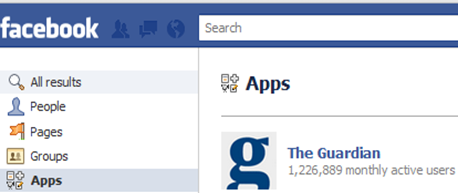
The Guardian reported their millionth Facebook app sign up over the last week and seems to be growing steadily. The Washington Post Social Reader and the WSJ Social, on the other hand, have a bit of a ways to go.
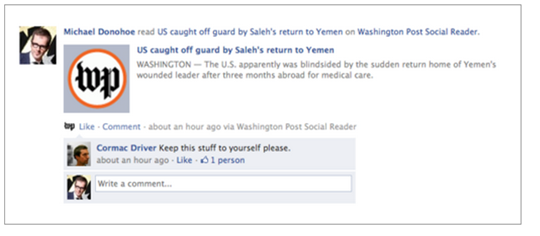
Not every Facebook user is happy with the idea of sharing every article he or she reads, nor do friends necessarily want to see your detailing each story read. Privacy and tedium are both concerns here. Michael Donohoe has a great post here about what happens when your friends notice you are reading certain things.
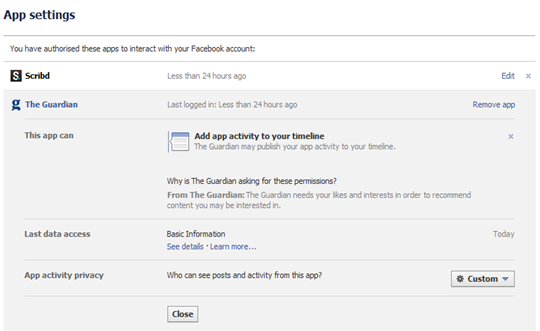 As with many Facebook-related things, there are privacy controls so that users can block their friends seeing certain activities or stop an app from posting to their timeline, but they may not be incredibly obvious or easy to locate/use. It might be hours after your profile has shown that you’ve read a controversial article that you realize it was there, as it’s not always obvious what gets posted to your profile and what doesn’t. By that time, conservative colleagues will have already seen it. It depends how careful you are about locking down your Facebook profile and whether you care about others knowing what you’re reading.
SUMMARY
Facebook’s huge push at F8 of both their Social Graph and news apps using Facebook mean we will see more and more of these types of apps, especially from media and news companies looking for new audiences. It will be interesting to see statistics on whether the “likes” and application users convert into subscriptions and/or traffic for the sites themselves. In the meantime I’d like to ask the news sites to consider that if the apps are in fact working well, maybe it’s worth taking some of the minimized design from the apps back to their own sites to see if it makes a difference.