Last week’s look at Irish Newspaper websites and applications was a bit depressing. So this week, I’m looking at some of the newer and more tech-friendly alternatives: TheJournal.ie and Storyful. Neither of these news sources have alternative print formats, they are both digital-only.
 THEJOURNAL.IE
TheJournal.ie is an Irish news website which invites users to “shape the news agenda.” Produced and owned by Distilled Media, TheJournal.ie has partner sites for business, sports and entertainment news as well (all linked in the top navigation bar). While it’s been around since early 2010, TheJournal.ie is currently in public beta. This means the site is visible to the general public, although it may continue to test and trial new features so there may be glitches or new bits and pieces from time to time.
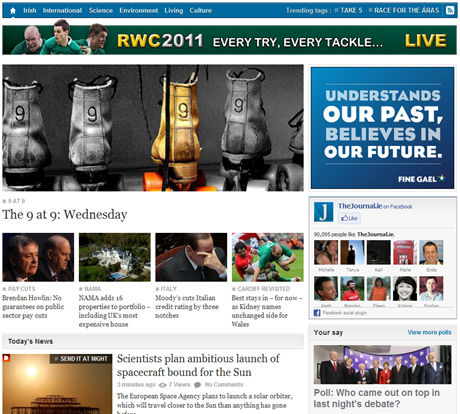
TheJournal.ie’s front page is a modern and less formal site powered by WordPress. It is attractive and easy to navigate. The tagged thumbnails and summaries are great and make it easy to browse headlines and stories. My only complaint is that some of the animated advertisements on the front page, like the Fine Gael one above are quite jittery and take away from the ability to pay attention to the headlines & summaries. Other advertisements I’ve seen on the site are much nicer, notably the ones produced by other Distilled Media sites like boards.ie.

The “Trending tags” link at the top of the front page (and also waaaayyyy at the bottom) shows off TheJournal.ie’s ability to do something most other Irish newspaper sites can’t/don’t: tagging articles.* Clicking one of the trending tags shows a list of articles relevant to that tag, when the article was posted, how many views & comments it has had, a brief summary and quick links to share via Facebook and Twitter.
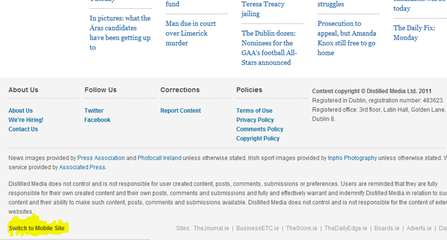
TheJournal.ie has a mobile version of their website which can be accessed at http://m.thejournal.ie or by clicking the link at the bottom of the main page as shown above.
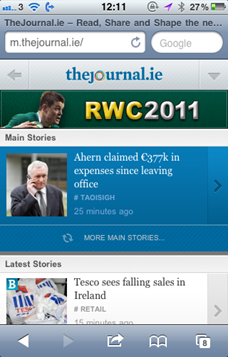
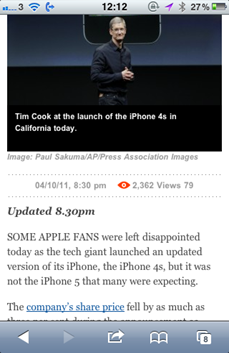
The mobile website is excellent and streamlined, focusing on the top main story and the most recent stories with a small downward arrow icon to allow the user to switch to one of the different online properties. As the list of articles is long, it can take a bit of scrolling to get to things like trending tags or most commented articles. The articles themselves are fantastic, very easy to read with nice typography and images. I tried the mobile site on both an iPhone and a Windows Phone 7 and both looked great.

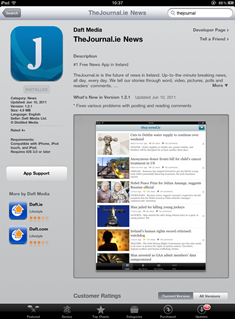
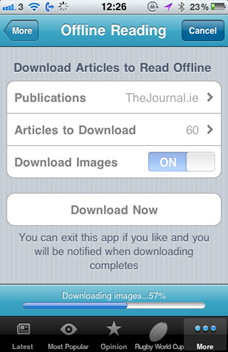
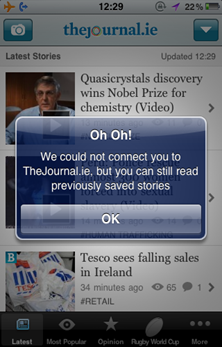
As far as apps go, TheJournal hardly needs any because the mobile site works so well. However the iOS apps add a nice navigation bar at the bottom for Latest, Most Popular, Opinion, More and timely events like the Rugby World Cup. But the best part about the iOS app, which they should definitely advertise more loudly, is the offline capability. The app allows a user to download between 30-120 articles and their images so that you can read while offline. I tried this while in airplane mode on my flight today and it was great, the only things inaccessible are of course online videos.
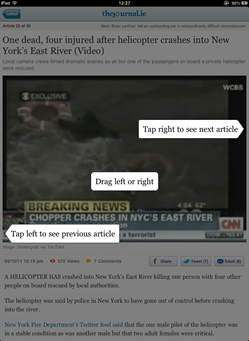
Navigation in the iOS app takes a little bit of getting used to, you can scroll through the articles and swipe or tap the sides to move to the previous or next article. The Search function is hidden in the “More” section. It might be more useful on the main navigation or if the tags are sufficient for most users, it could probably be removed.

Although TheJournal.ie is still relatively new, it boasts over 800,000 monthly visitors, 60,000 readers on the Android & iOS apps, and an additional 80,000 Facebook & 20,000 Twitter followers. Very impressive stats for a group that has to compete with more established and familiar Irish news sources. I am confident that TheJournal.ie will continue to grow and increase its presence and influence in the Irish news space. I would definitely not be surprised if this was a model they could abstract out and license to other areas similar to Ireland where the main news sites are more old school and less adaptive.
 STORYFUL.COM
Storyful, now a little over one year old, uses a different approach to TheJournal.ie and most other news websites by taking the perspective that there is always someone closer to the story. Sources might be local news professionals or amateurs, but they’re often simply regular people who are in the right place at the right time.

Storyful has a “storybuilding tool” on their site which allows users to publish directly to the website. Users can post to community pages and share stories with friends on Facebook and Twitter to reach an audience all around the world. It’s a unique model which allows Storyful to share the stories it collects with news sources and major global news organizations all over the world. 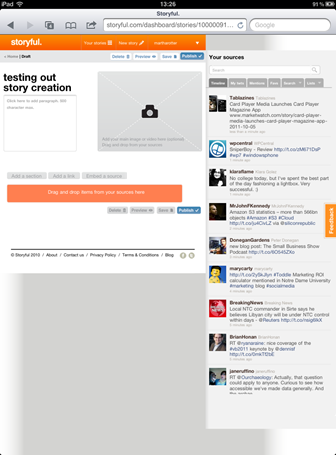
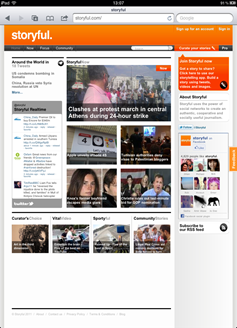
Navigating Storyful’s website is not incredibly obvious if you’re looking for a more standard style of news website. Storyful’s front page presents a few thumbnails of what’s happening now along with things like Around the World in 18 Tweets and real-time Twitter updates. Towards the bottom it has regular spots like Curator’s Choice and Community Stories which highlight specifically chosen stories. However if you’re looking for a story that happened yesterday or some general news headlines for European financial stories, it’s not really built for that style of navigation. You can use the search bar to search by topic, but Storyful is not “the daily newspaper.” Storyful is latest news, worldwide news, told by courageous people affected by the story. If you want great storytelling and fascinating insights and the most up-to-date developments, this is the place. If you want stock closing prices and the sports scores from yesterday, you’re probably better off on a more traditional news website.
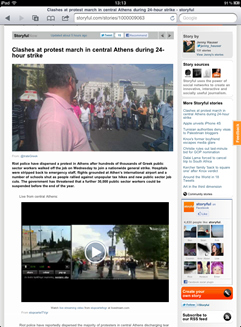
Storyful has a vibrant community of contributors, and their contributions are in various languages, accompanied with photos, videos, tweets and comments, often from people at the scene of unfolding breaking news. There is no other way to feel closer to a brand new story than by watching these posts get put together and reading what develops. I know the feeling of continually refreshing Twitter searches for breaking news like the Arab Spring events and London Riots because no news site is going to have the latest turn of events, and feeling thrown into the moment while reading quotes from people who are witnessing it happen. Reading a great Storyful item is a bit like that, but much better organized and with supporting media.
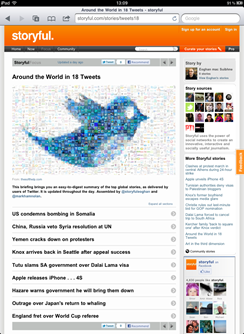
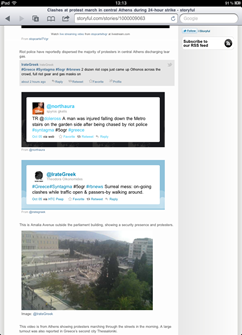
There is no http://m.storyful.com, and unfortunately it doesn’t adapt much for smaller screen sizes, so if you are using it on a phone you will have to do some panning and zooming. However it looks decent on an iPad, better in landscape mode than in portrait mode, which leaves a lot of unused whitespace at the bottom. There are definitely some optimizations Storyful could do for mobile devices and smaller screens, a responsive layout being one. Another thing that might be useful is be a “snap-and-upload” instant story creation tool. With Storyful’s audience being worldwide, they’ve done the right thing by avoiding mobile apps and just focusing on the website to reach the most people. Many poorer and rural areas use very barebones phones but can still access the web with them; allowing these would-be reporters to maintain access to the story building tool is key. It would also be interesting to see geolocation functionality here, something like a “Breaking news near me” type of option.
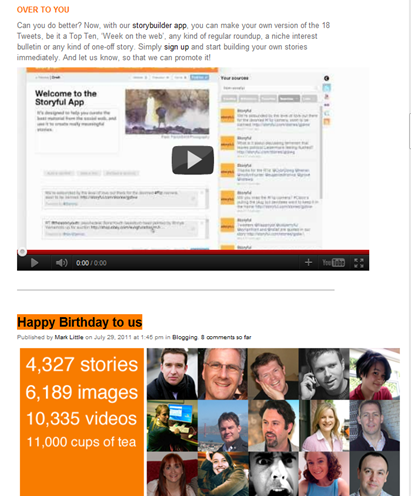
Something Storyful got right that no one else has yet in Ireland is the personal, behind-the-scenes connection from their blog at http://blog.storyful.com/. This is a great way to show upcoming developments, share what’s new and how it works if relevant, showcase insights gained from analytics and user feedback and just generally let users understand the folks behind the creation of the site a little better. Storyful’s blog has bits and pieces about recent stories they’ve posted, but it also has some very insightful posts on how and why it works the way it does. I look forward to seeing more Irish news sites follow their lead and be more transparent about their inner workings.
SUMMARY
This area is so fascinating to watch because without the baggage of an existing brand, new news sources can do some very interesting things. Things like Facebook and Twitter integration are not mere add-ons for these sites, they’re integral to how the sites work. Embracing new ways of communicating and sharing helps these sites to grow their audience, and in a time where ad spend is vital to survival, audience statistics will go a long way to building and keeping advertiser revenue.
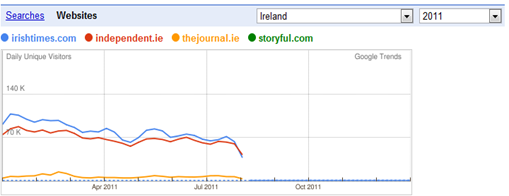
Looking at Google Trends is one way to see general traffic over time, and you can see below that for 2011, traffic is decreasing slightly to bigger sites while jumping around but still slowly increasing over time for TheJournal.ie (Storyful stats were unavailable so they’re not on the chart). These are very forward-thinking organizations and I applaud their hard work and determination to break the status quo.
*Unless you’re talking about The Independent’s random highlighting of words inside articles, which is very bizarre and certainly not helpful. I was reading a food article recently which had two hyperlinks in it: path and tricky. Clicking either word took you to a page where any other articles containing the word path or tricky were listed. Why would that ever be useful? The Independent needs to lose that automatic linking, whatever it is.