Data journalism, news apps, open government data. In this age of Anonymous, Wikileaks, and proactive sources publishing freely available data, it is becoming critical that we have journalists and developers working together to make sense of it all and understand how it affects us.
Today there are a growing number of news outlets doing a fantastic job of both publishing data and creating interactions and visualizations to make sense of it. I wanted to showcase a handful of those sites so that people can understand why this type of journalism is important and how it works. And maybe even how to get involved if it’s of interest to you.
DATA SET PROVIDERS:
There is no shortage of people providing data sets today, the only thing to learn is how to narrow it down to the most useful one for you.
Fingal Open Data is doing a nice job in Ireland encouraging councils to open up their data. Their site http://data.fingal.ie/ provides data in CSV, XML and KML formats, and they’re currently running a competition for people to build useful apps given the available data.
Additionally in Ireland, sites like Gavin Sheridan’s The Story and John Handelaar’s Kildare Street are excellent resources for presenting data but also learning more about the types of data available in Ireland
I mentioned The Guardian’s Data Blog in a recent post about news developer blogs as a great example of community building. But clearly it is also one of the best sources in the UK for a wide range of freely available data sets. For each set of data they post, they offer a download of the data and recommend that if you do anything with it, you post it to their Flickr group. They often have additional visualizations and comparisons as well.
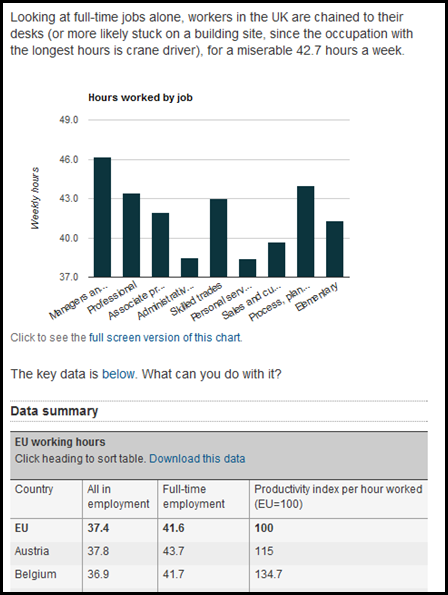
There are loads of additional resources for finding data, the trick is knowing how to search for the information you need. Sites like ScraperWiki (https://scraperwiki.com/), DataSift (http://datasift.com/), The World Bank (http://data.worldbank.org/), BuzzData (http://buzzdata.com/) and more sites are growing and becoming available to the public for research and data mining.
NEWS APP EXAMPLES:
It’s no coincidence that a lot of my news app examples have shown up in prior blog posts – there are some organizations who are very seriously ahead of the pack in terms of understanding how news and technology work together. On one hand I am delighted to have bright minds like these folks paving the way! On the other hand, it makes me a little depressed when I realize that Ireland is nowhere near this level of thinking.
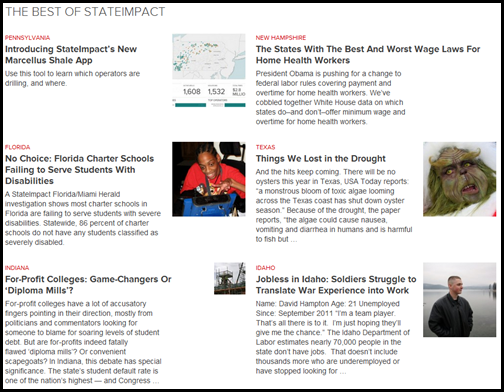
NPR’s StateImpact (http://stateimpact.npr.org/) is a collaboration among NPR and local public radio stations in eight pilot states to examine public policy issues in depth. They provide explanatory, data-driven stories focused on how people’s lives are affected by government decisions.
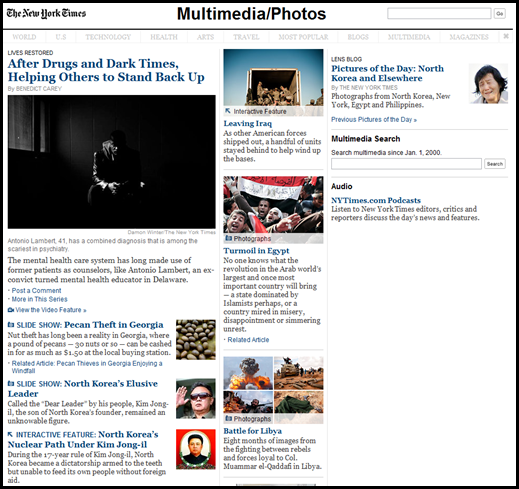
The New York Times definitely has a well-respected team of interactive news developers and infographic designers. However it’s not always very easy to find them on their site. The Multimedia page is the best resource I’ve found for taking a look at cool interactive apps and images they create, but Small labs Inc has also put together a nice collection here: http://www.smallmeans.com/new-york-times-infographics/
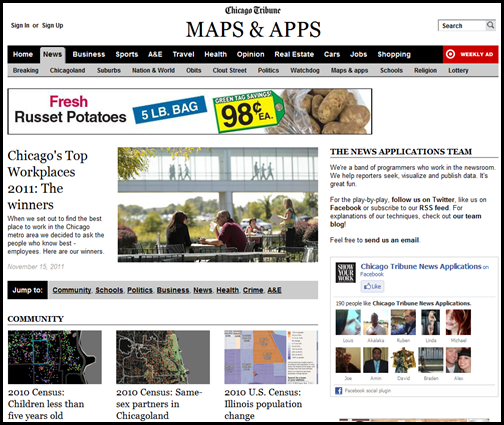
The Chicago Tribune has some of the busiest & best news app builders in the United States today and they are constantly kicking out new, interesting information in nice visual formats. Check out their site which has apps in many areas including community, schools, business, politics and more.
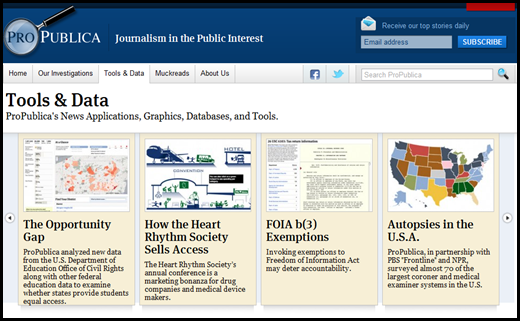
ProPublica creates not only fantastic interactive news applications like Dollars for Docs (which I referenced in my Quantified Self talk on skin problems), they also create excellent reusable tools like DocDiver that allow readers to work with the ProPublica reporters.
DATA JOURNALISM RESOURCES:
To learn more about data journalism, here are a few useful sites to check out and blogs to follow:
The Data Journalism Handbook: a work-in-progress coordinated by the European Journalism Centre & the Open Knowledge Foundation launched at the Mozilla Festival in London on November 5th 2011.
Data Journalism Blog: http://www.datajournalismblog.com/
Hacks/Hackers: http://hackshackers.com A grassroots journalism organization on a mission to create a network of journalists and technologists who rethink the future of news and information.
ProPublica’s Dan Nguyen’s Scraping for Journalism: A Guide for Collecting Data http://www.propublica.org/nerds/item/doc-dollars-guides-collecting-the-data – a great introduction to how to grab data that is in maybe less-than-optimal formats.
Also from Dan Nguyen, The Bastards Book of Ruby http://ruby.bastardsbook.com/ – an introduction to programming and its practical uses for journalists, researchers, scientists, analysts and anyone else who needs to make sense of data.
At the Society of News Design conference earlier this year, I went to some excellent talks by newsroom app developers who recommended that if you are thinking of going into this area, you need to know either Ruby on Rails or Django/Python, as those seem to be the dominant requested skills for news apps. I also liked this article recently on Poynter about using Backbone to create data news apps: http://www.poynter.org/how-tos/digital-strategies/147605/how-journalists-can-use-backbone-to-create-data-driven-projects/. You don’t need to know everything, just pick one and start creating projects.
And lastly, from the perfect timing department, here’s Matt Stiles, who is a data journalist from NPR, talking very recently about best practices in building news apps:
Data Best Practices from StateImpact on Vimeo.


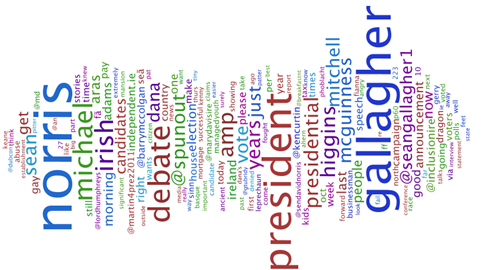
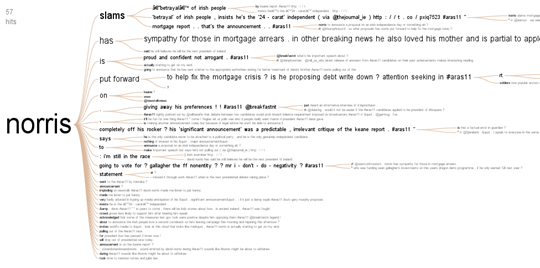
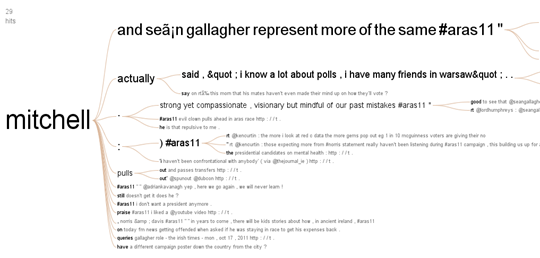
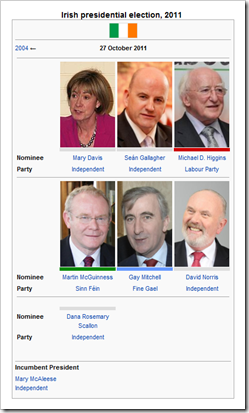 The Irish presidential election is just about a week away. As a non-citizen resident of Ireland, I can’t vote in this election (only local elections). But I still find it interesting so I took a look at some social media data on the topic to make some visualizations. These are not meant to be predictions, it’s just a bit of fun to see what people are thinking today in Ireland.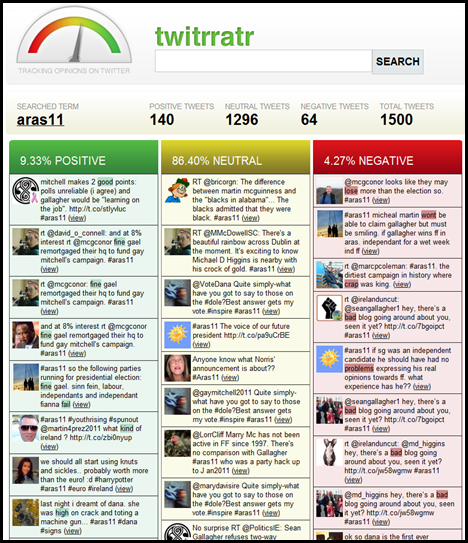


 Cross-Platform Editing – Teresa Schmedding is the president of the American Copy Editors Society and also an assistant managing editor at the Daily Herald in Chicago. Teresa talked about trying to hold the line between editorial quality and actually getting stuff out the door. Her stories of pet peeves of writers and editors she’s dealt with were highly entertaining. It’s hard to know what’s worth fighting for. You will have readers who will write and complain about certain edits so you have to know what your standards are.
 Designing a Responsive News Website – Everyone working on the web at this point has to have seen the Boston Globe redesign at

 How to Make News Apps in your Newsroom – Several times on this blog I’ve mentioned the fact that trying lots of different things and being able to work news, magazines and media more like an agile start-up is a great way to get ahead of the competition. Brian Boyer from The Chicago Tribune and Scott Klein from ProPublica talked about news apps which are software. This is a new area, so these aren’t people in your company who can fix your computer or get the server back online, they’re people who can build newly capable applications to visualize stories or interact with users.
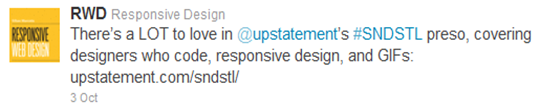 Finding the Web Designer Within – These two guys from Upstatement had amazing slides that they published ahead of time so you could follow along. The slides are great because they point out that a lot of what news designers have been trained to do are very useful skills for web design. Things like grids, typography and being able to organize volumes of information are all skills that can transfer to web design.
 Adios, Arial! New Tools for Taking Beautiful Typography from Print to Digital – Typography is so important for readability on the web, and Alan Tam, Sam Berlow and Danny DeBelius gave a great talk and examples on why you need to test every scenario, why the results can change and some technology to use to help. Sam recommended tools like the web font preview on
  Closing Keynote with Robin Sloan and Matt Thompson – This presentation was definitely one you did not want to be late for. The session was live-streamed, and below is the video. Robin and Matt are amazing speakers and it’s definitely worth watching their take on what the future of reporting a natural disaster might be like with their video called The Storm Collection and the brilliant talk that follows:
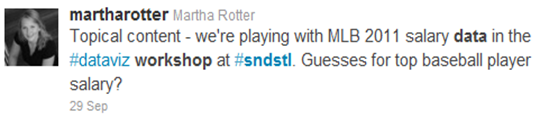 DATA VISUALIZATION WORKSHOP
 CONFERENCE DAY 1
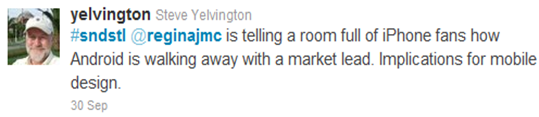 Mobile & Tablet Research Roundup – This was an overview of tablet and mobile research by Roger Fidler & Regina McCombs. Some interesting stats from thinkMobile & Google research on how people are using smart phones
 Fun101 — A strange title for a talk at a news design conference, but Fun101 with
  Designing Personalized Tablet News – This was a panel with Bobby Ghoshal from Flud, Mark Johnson from Zite & Joey Marburger from Trove. It was a good panel where each aggregator talked about their decisions on multiple platforms, how much setup to give the user (i.e., do you seed them with feeds, let them choose, etc.), how they allow users to share, revenue streams and more. My takeaway from this was that these are in a dangerous spot as they rely a great deal on the lack of pay walls or a system to integrate with news sites. The aggregators don’t want to do a ton of work for each site they allow their users to access so the tougher a news site’s pay wall, the more likely the aggregators won’t include it. Having just seen the fantastic film
  Keynote Speaker: Rob King – Rob King, VP & Editor-in-Chief of ESPN Digital Media gave a fantastic talk on dealing with change in your personal and professional life.
  Designing the Magazine and Issue-based Tablet Experience – This talk was given by Mike Schmidt from The Daily, Claus Enevoldsen from Next Issue Media and Robert Newman from Reader’s Digest. Very good session on the tools they use, how they spend their time and production flow. I was terrified to learn that at The Daily, there are 50 people on just the design team, and that they have no automatic templates so every day they handcraft over 100 pages. Then they do it again in portrait mode. Yikes.
 Touching News: The New Rules of Tablet Media – This session was one of the ones that made me sign up for this conference. I read Josh Clark’s book Tapworthy earlier this year and loved it. Josh had some of the best slides of the event, but he also automated his Twitter account to tweet additional interesting blurbs about his talk as he was speaking. Magic! Josh had excellent UI tips, usability and interaction examples, and was basically all around brilliant. Excellent speaker – go listen to him if he’s speaking near you any time soon. His beautiful slides are here:
 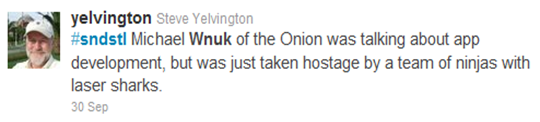 Building in HTML5 & Bypassing Native Apps – I loved this session, not just a little because one of the developers from The Onion was speaking. Alan Herzberger from The Oklahoman & Michael Wnuk from The Onion gave very honest overviews of why they chose to build with HTML5 instead of iOS and their internal processes that happened for design, development, CMS modification, etc. Very interesting and candid discussion about the pain they went through, what works and what doesn’t.
  Visual Conceit: The Secret Ingredient of the Secret Ingredient – Adonis Durado has a tough job. As Design Director of two newspapers in Oman, he works with designs and layouts in both English and Arabic and has to deal with a very reserved audience where showing skin to get more readers is not an option. Adonis talked about creating pages and layouts that make people think and surprise them. He showed a lot of examples of his papers’ compelling designs and “Wow factor” creations. He cited hiring a diverse team with different backgrounds and voices as one of the defining factors of his successful transformation of the papers from unknown to award-winning. His hand-out from the talk is here: