Exciting Idea Magazine Addition: Help with Hiring

idea-logo-whiteIf you’ve tried hiring people in the tech industry lately, you know what a tough and competitive market it is right now.

Idea Magazine wants to help.

Today we’re opening up a limited amount of job listings for our inaugural issue launching December 8th. We’re not interested in posting bulk ads with hidden company names. We’re not interested in posting vague descriptions of what someone might be doing. We’re not interested in posting ads for interns to work for free. We’re not interested in posting ads for companies hiring you so they can outsource your skills.

Here’s what we ARE interested in: we want to connect great people to great startups & tech companies. And we think the best way to do that is by being transparent and helping you find each other.

Our job listings cost only 35 Euros each and are featured in both the website and the magazine itself. This is a great deal as it delivers your ad to a very targeted audience of people interested and working in technology in Ireland and Northern Ireland.

We will be selective about which job listings we post so that a) they’re not overwhelming for the readers and b) your job has a chance to stand out.

You have the chance to make your position stand out – jobs will contain the below information so that the candidates contacting you will understand the requirements and be excited about joining your team.

To get your startup job posted in the first issue of Idea Magazine, launching December 8th, fill in the form here: http://readidea.wufoo.com/forms/idea-magazine-startup-job-ads

Feedback on our job listings? Let us know! Email martha [at] readidea.com.


SAMPLE JOB LISTINGS:

Blue Pony Media

Graphic Designer, Advanced

Skills required:

Strong graphic design and logo design skills, Photoshop & Illustrator

What you’ll be working on:

You’ll be working with our publishing and media clients to help them design beautiful and appropriate designs and logos for their interactive applications. Understanding an organisation’s vision and helping them to realise that is a big part of this role.

Why our company rocks:

Blue Pony Media is an award-winning media agency, creating interactive applications which delight people everywhere. We are very picky about which customers we take on to make sure to make sure we are proud of the work we do. Blue Pony Media values talented designers and developers and our extremely low turnover rate is proof of that. We’re located in Wicklow, but for the right designer, we’re open to a remote work option.

Blue Pony Media is a mature company with 10-20 employees.
To apply or for more information see: http://omgponies.com/jobs

SuperCrazy Games

XNA Developer, Beginner/Intermediate

Skills required:

C#, XNA, Physics libraries such as Farseer would be a nice-to-have

What you’ll be working on:

You’ll be taking our concepts and turning them into interactive, playable mobile games. Building on top of our internally created animation foundation, you have the tools you need to iterate quickly and be creative. Our games run on PCs and Windows Phone 7 but we’re also building an environment to distribute our games through Xbox Live very soon.

Why our company rocks:

As a small but busy games studio, we’re turning the mobile games industry on its head. We’re agile and creative, so this is your chance to get in early and impact the future of mobile games by helping us create unique, viral concepts. We take fun very seriously, and our office is located in a developer hub in Galway so there’s plenty of excitement around. We believe in working flexible hours and doing anything we can (like bringing in lunch and providing you with the latest mobile devices) to help you focus on exciting projects.


SuperCrazy Games is a Startup company with 1-10 employees.
To apply or for more information see: http://wearesupercrazygames.com/jobs

A New Idea

Idea Magazine

For a place with such an amazing tech community of developers, designers, startups, entrepreneurs and just plain “do-ers”, it’s shockingly hard to know what’s going on all the time with the Irish technology scene. The most effective way to find out about interesting startups, new technologies, cool design studios, great places to work, upcoming events, testing techniques, great new fonts, etc. is usually an impromptu meetup with a fellow geek.

When I moved to Dublin four-and-a-half years ago I spent a lot of money on technology magazines, from Ireland and abroad, to find out what was going on (still do – I am a magazine junkie). Foreign magazines always had cool profiles of interesting people, tutorials on things that are new and might be useful techniques, list of stuff that was going on and things to get involved with.

I rarely read about anything interesting happening in Ireland. <sadFace/>

But at the same time, I was constantly blown away by unique companies being created here. Things like Build (happening this week in Belfast for the third year!), Coder Dojo (happening every weekend now!), 24theWeb (2nd annual event happened a couple of weeks ago!), that are all creative and beautifully executed initiatives. Studios that turn out gorgeous websites and mobile applications. People turning industries on their heads.

AUGH! AREN’T YOU SO FREAKING PROUD OF IT ALL?!

But there’s no platform for talking about it yet. Existing publications write about global gadgets & popular “apps you need now!” They cover huge sales deals. They publish bland PR for big brands. It’s time for something new.


WITHOUT FURTHER ADO

image

I’d like to introduce Idea Magazine. Idea Magazine is a brand new, bi-monthly digital magazine by and for the tech scene of Ireland and Northern Ireland. We’ll be launching on December 8th with our first issue available online for free.

Idea Magazine aims to highlight startups and technology created in Ireland and Northern Ireland, along with excellent design, educational programs and training, investment and business-related information of interest to the tech community. Things like “Which accelerator program has the best terms”, “What should you know about patenting your software”, “Tips for increasing customer engagement in web apps”, “Which tech events are happening next month”, and much more will be covered in Idea Magazine.

Together with the incredibly talented Stewart Curry as Design Director, we have an excellent team working together to make sure we are covering interesting, relevant and useful topics for you, the tech community. If you have suggestions or things you’d like to see in future issues of Idea Magazine, please feel free to contact me at martha [at] readidea.com.


WHERE CAN I LEARN MORE?

If you’re interested in learning more, you can go to (the very lovely and responsive) http://readidea.com & sign up for our newsletter today or follow us on Twitter at @readidea. Our launch is only a month away, so we’re busy getting our content and new platform ready for you.

I’d love your feedback and suggestions any time & look forward to creating an outstanding magazine for an outstanding community.

Visualizing Áras Election, Part Two

I received some good feedback on additional things people thought might be interesting to look investigate regarding next week’s election. So today I’ve done two things: 1) Taken a brief look at media outlet perception of candidates based on published articles and 2) Re-examined the Irish twitter stream with a new sentiment engine to see how the individual candidates stack up against each other.


NEWS SOURCE PERCEPTIONS

Once again using ScraperWiki, I picked two different news sites to scrape for their election coverage. RTÉ and The Irish Times both make it a bit awkward to find all of their Áras election coverage in one place. On RTÉ, the best source was http://www.rte.ie/news/presidential-special-reports.html, but I’m not positive it’s comprehensive as it was a link I stumbled on to while digging around their site.  For The Irish Times, I used a search function to pull up 100 articles containing the word “Aras.”

The best site, which I ran out of time today to include but will add it later, is unsurprisingly TheJournal.ie as they have a nice tagging system. You can simply visit http://www.thejournal.ie/topic/race-for-the-aras/ for all of their great election coverage.

Back to The Irish Times and RTÉ: using scrapers to comb through their HTML I pulled out article titles and descriptions to get a brief understanding of what tone comes through and who is talked about most. With more time, one could easily walk through all of the articles and grab and parse that text as well, but this is a basic exercise. Another tough thing about RTÉ’s coverage and what may limit me digging deeper there is that they have so much video coverage and I couldn’t seem to find any transcripts of video reports. Parsing audio into text from video reports is a whole other project!

The Irish Times:

The Irish Times election article word cloud

RTÉ

RTE election article word cloud

The data sets and visualizations are all linked on my Many Eyes page here in case you’d like to do your own visualization of the data.


IMPROVED TWITTER SENTIMENT

In my last related post, I used twitrratr to do a very simple analysis of how people in Ireland were feeling about the election. However it is a very simple application and I wanted to expand on it, using a better sentiment algorithm. 

R is a statistical computing and graphics generation language and tool. R allows very interesting and complex analysis of language and data. I used two R tools to help source and evaluate the Tweets.  First I used Jeff Gentry’s twitteR package which has some very easy methods for searching twitter timelines. A search for tweets related to David Norris, for example, might look something like this:

norris.tweets = searchTwitter(‘aras11 AND norris OR david OR SenDavidNorris’, n=1500)

where the words in quotes are my search terms and the n=1500 refers to how many tweets it should return. So I built queries like these to search for tweets related to the individual candidates.

The next tool I used was an “opinion lexicon” by Hu & Liu. If you’re not familiar with processing language, the easiest way to explain this is it’s a big dictionary with almost 7,000 words which are categorized as positive or negative. Words like “love” or “amazing” would be categorized as positive, and words like “hate” or “sucks” would be considered negative. Of course this doesn’t allow for sarcasm, so we have to assume that most people mean what they say. In the future maybe we’ll have to also search for a “sarcasm” hash tag and then reverse the word values!

With the opinion lexicon, we can go through all of the tweets and score them depending on whether the words in the tweet are more positive or negative.

Finally, we can plot the answers on a histogram as shown below. The diagram is a bar chart showing for each candidate, how many tweets were considered positive versus negative. We can see that Dana Scallon has relatively more negative tweets than the others, and that Michael Higgins has relatively more positive tweets than the others. Higgins also seems to have the widest variety, with tweets going up to a score of six and down to a negative five.

Histogram of Irish Candidate Sentiment on Twitter

*many thanks to Jeffrey Breen for his excellent slides on Twitter text mining and for publishing the code – very helpful!*


WHAT ELSE?

I’d like to go deeper into the actual published articles, which will take a bit more time but could provide some interesting results.  I would also love to look at additional sources such as TheJournal.ie and The Irish Independent.  As I have with the previous charts, I’ll continue to update these daily until the election and see if Twitter is able to make a good prediction about the final result. 

After the election I’ll also do a blog post on how to create your own data visualizations from public sources with easy tools that you don’t have to be a programmer to use.

Visualizing Áras Election

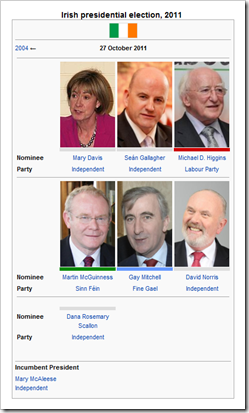
(image from Wikipedia)The Irish presidential election is just about a week away. As a non-citizen resident of Ireland, I can’t vote in this election (only local elections). But I still find it interesting so I took a look at some social media data on the topic to make some visualizations. These are not meant to be predictions, it’s just a bit of fun to see what people are thinking today in Ireland.
I am using a tool called ScraperWiki that I learned earlier this year at a Hacks and Hackers Day in Dublin. ScraperWiki lets you scrape data from various sources such as a PDF or in this case, Twitter. My scraper grabs any tweet mentioning aras, aras11 or president originating from Ireland.


JUST THE WORDS

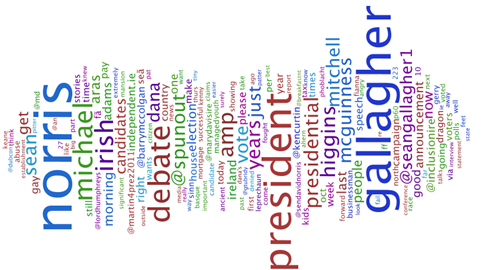
We can use a tool like IBM’s Many Eyes to visualize the most frequently referenced words in these tweets. The visualization below, embedded from Many Eyes, shows that Norris and Gallagher are probably the two most discussed politicians on Twitter.  You can right click on the visualization to alter it, remove certain words (I removed things like “RT” and “QUOT” and “ARAS11” as they weren’t relevant), change colours, etc.

*NOTE: Many Eyes is a Java tool, so you will need Java to interact with the data. If you can’t view the visualizations, please scroll to the bottom where I have screenshots of the data instead*


WHAT ABOUT ASSOCIATIONS?

More interesting than the individual words themselves, to me, are the associations they have. In other words, is one candidate’s name mentioned frequently in the context of other certain words or phrases?

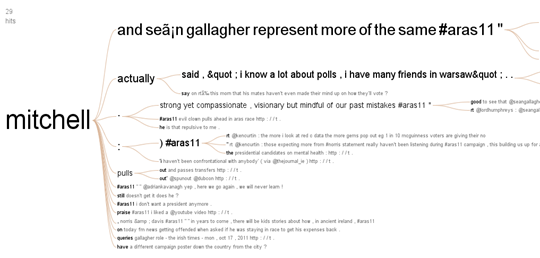
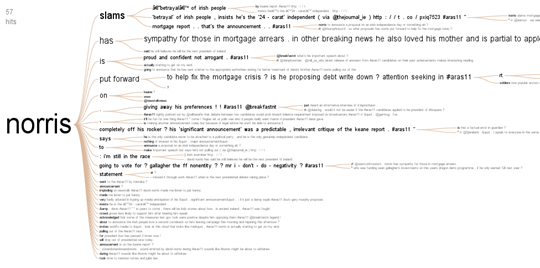
The Customized Word Tree, another tool from Many Eyes, allows you to upload a text and then enter specific words to find other terms associated with it. To use this interactive tool, simply type in a name like “Gallagher”, “Norris”, “Dana”, etc. into the Search textbox & hit return. You’ll see a visualization of words and phrases most frequently associated with that candidate.

*NOTE: Many Eyes is a Java tool, so you will need Java to interact with the data. If you can’t view the visualizations, please scroll to the bottom where I have screenshots of the data instead*


SENTIMENT

Does anyone care about sentiment analysis anymore? Sentiment analysis is trying to understand the general feeling, positive or negative, from a group given a topic. So if you did sentiment analysis on Twitter for the term “taxes”, you’d probably find most people associate that with negative feelings, frown emoticons, and an overall negative sentiment. Unless of course the government had announced huge tax refunds for everyone, in which case it would likely be overwhelmingly positive.

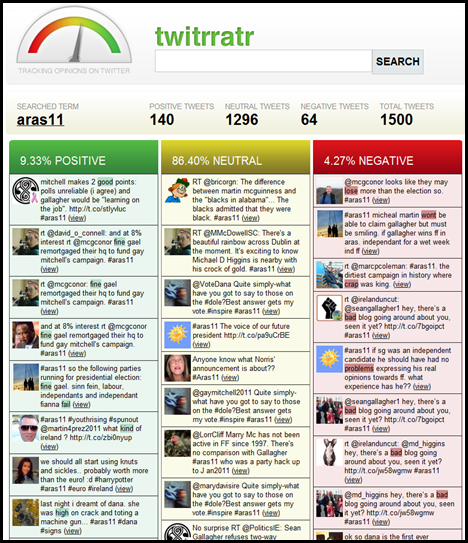
twitrratr is an example of a tool that does sentiment analysis given a topic. It’s as simple to use as Twitter search, but the results in this case aren’t incredibly useful.  You can check the sentiment yourself easily by clicking here: http://twitrratr.com/search/aras11.

twitrratr


HOW TO CREATE YOUR OWN

ScraperWiki is great because you can use a variety of programming languages and it has support for lots of different sources including PDFs which are notoriously hard to parse.

I forked a basic Twitter scraper that looks for tweets containing keywords. You can see my scraper here: https://scraperwiki.com/scrapers/aras_election_data/.  The Twitter search API lets you use regular expressions, so I edited the keyword to be ‘aras OR aras11 OR president’.  Searching for president could definitely bring up irrelevant tweets for this purpose, so I also added a geolocation query. The Twitter search API lets you use a latitude & longitude followed by a radius to find tweets in a particular area. I added some very simple Python code to the scraper to allow it to handle geolocation queries.

As you’re developing your scraper, you can run it every time you change something to make sure you are getting the results you expect. Once you’ve finished, you can schedule it to run daily, weekly, etc.  If you get stuck, the ScraperWiki community is a great group of people, they have a very active Google Group and growing documentation.

Once you have the data you need, you can export it as a SQLite database or a CSV file. There are plenty of tools you can use with this data. Many Eyes is a good one to start with as it’s very user friendly. If you’re into programming, there are many good JavaScript libraries and other tools you can use to manipulate the data.  Just search online for things like “data visualization tools.”


MORE ON THIS

My scraper runs once a day, so I’ll be updating the interactive charts daily from now until October 26th when the election is held. If there’s other information you think would be useful or interesting to look at, related to the candidates or the upcoming election, please leave a comment and I’ll take a look.


SCREENSHOTS FOR THOSE WHO CAN’T VIEW MANY EYES

Word Analysis:

Many Eyes Word Cloud


Candidate Association Examples:

Many Eyes Word Tree

Many Eyes Word Tree

Many Eyes Word Tree